Corporate Governance
1. Corporate Governance Philosophy
Aozora aims to achieve sustainable growth and enhance corporate value by incorporating its management philosophy into its daily business operations. For this purpose, Aozora has established a disciplined management system and positioned the proper establishment and effective operation of its corporate governance structure as an important management initiative while striving to continuously strengthen it as a foundation for pursuing transparency and efficiency.
As a Company with an Audit and Supervisory Board, Aozora has established the Nomination and Remuneration Committee and the Risk Governance Committee as voluntary advisory bodies to the Board of Directors. In addition to the fact that a majority of our Board of Directors consists of outside directors, the chairperson and the majority of the members of both committees are independent outside directors, thereby ensuring the independence and objectivity of the Board of Directors. The majority of the Audit & Supervisory Board is also composed of outside Audit & Supervisory Board members, and we have established an environment where each auditor can actively express their opinions to the Board of Directors.
Through the separation of management oversight and business execution, the Board of Directors determines basic management policy and strategies and oversees the execution of business operations, while executive officers conduct daily business operations with authority delegated to them by the Board of Directors. The Management Committee is the highest decision-making body for the execution of daily business, and is comprised of members from among the executive officers, who are approved and appointed by the Board of Directors. This structure improves the speed of decision-making, while subcommittees are also established to improve efficiency in the execution of business operations.
Corporate Governance Structure
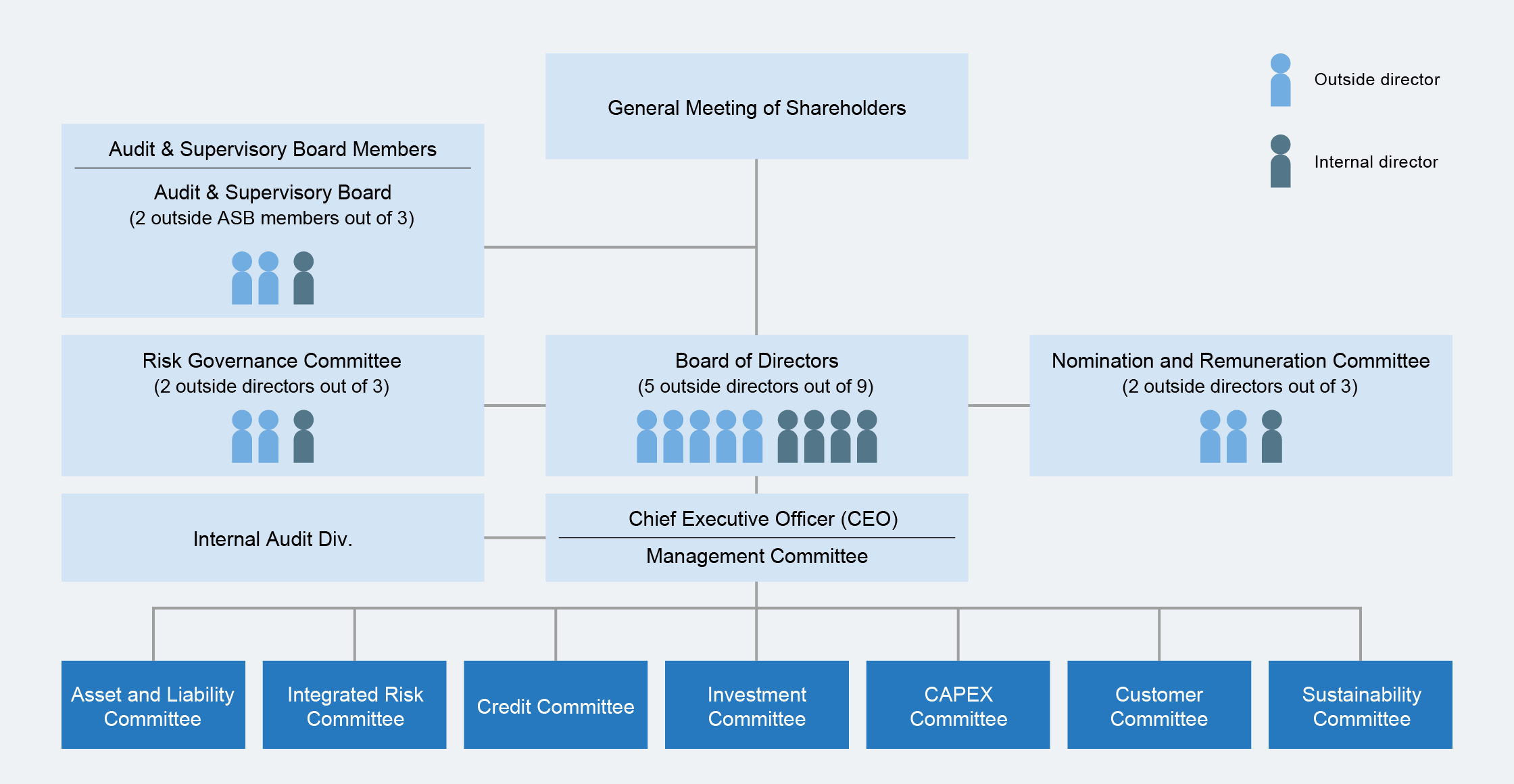
- Five of the six outside directors are designated as independent.
Overview of Each Meeting Body
Board of Directors
- Chairperson:
- Hideto Oomi
The Board of Directors establishes important basic policies for business operations and oversees the execution of duties by executive officers entrusted with daily business operations. In addition, our five independent outside directors occasionally hold executive sessions, which are comprised solely of independent outside directors, to allow for the discussion and exchange of views on topics, including Aozora’s executive structure, key business issues, and the operation of the Board of Directors, from an independent outside director’s perspective.
Audit and Supervisory Board
- Chairperson:
- Tomoko Yugeta
Aozora operates under the Audit and Supervisory Board system. The ASB performs business and accounting audits regarding the execution of duties by directors and executive officers in accordance with relevant laws and regulations. ASB meetings are held with all ASB members attending to receive reports on important audit matters and discuss or resolve them as needed.
Nomination and Remuneration Committee
- Chairperson:
- Sakie Tachibana Fukushima
The Nomination and Remuneration Committee, the majority of which is comprised of outside directors, provides the Board of Directors with recommendations, including prospective candidates for Board and ASB members and other important employees as well as CEO succession planning. In addition, the Nomination and Remuneration Committee determines the remuneration of directors and executive officers and makes recommendations to each ASB member regarding their remuneration.
Risk Governance Committee
- Chairperson:
- Hideyuki Takahashi
The Risk Governance Committee, the majority of which is comprised of outside directors, serves as an advisory body to strengthen the effectiveness of internal control and risk appetite framework operations by the Board of Directors, and professionally deliberates important matters, including internal control, evaluation of the establishment and revision of the Risk Appetite Statement, and evaluation of the monitoring of the risk appetite framework.
Overview of the Management Committee and Its Sub-committees
|
Chaired by |
Purpose |
|
|---|---|---|
|
Management Committee |
CEO |
Determine important matters related to Aozora’s execution of its daily business |
|
Asset and Liability Committee |
CFO |
Monitor and evaluate important matters and deliberate and determine management policies regarding asset and liability management, including plans for the sources and uses of funds |
|
Integrated Risk Committee |
CRO |
Develop risk management procedures and verify and approve risk analysis methods, maintain a proper internal control environment and launch new businesses/products |
|
Credit Committee |
CCRO |
Approve credit transactions and establish a credit risk asset portfolio aligned with management policies |
|
Investment Committee |
CCRO |
Approve investment transactions, establish investment policies, ensure accurate understanding of investment risk, build and maintain a secure and profitable portfolio |
|
CAPEX Committee |
CIO |
Approve and monitor IT projects required to realize business plans and strategies |
|
CAPEX Committee |
Head of Corporate Strategy Unit |
Approve and monitor facilities-related projects required to realize business plans and strategies |
|
Customer Committee |
Head of Compliance and Governance Unit |
Deliberation and approval regarding the framework and measures for customer-oriented business promotion and customer protection management |
|
Sustainability Committee |
CEO |
Basic matters of Group-wide sustainability promotion as well as important matters regarding sustainability promotion mainly in Aozora’s business and initiatives as a business entity |
- CEO: Chief Executive Officer, CFO: Chief Financial Officer, CRO: Chief Risk Officer, CCRO: Chief Credit Risk Officer, CIO: Chief Information Officer
- The Board of Directors shall not have more than 12 directors, which is the maximum number of directors stipulated in the Articles of Incorporation.
- Nomination of Director candidates shall be based on the “Basic Policy for Nominating Director and Audit & Supervisory Board Member Candidates, and Appointing and Dismissing Senior Management Including the CEO.”
- The composition of the Board of Directors shall take into consideration diversity and mix of experience, with a wealth of knowledge and expertise in areas including banking and finance, financial accounting, risk management, legal and compliance, among other areas, in addition to deep insight of Aozora’s business.
- The Board of Directors shall be comprised of internal directors who possess extensive knowledge and experience in business execution and outside directors who supervise management from an objective standpoint. Judgment of outside directors’ independence shall be made based on the “Independence Criteria for Outside Directors and Outside Audit & Supervisory Board Members” and the percentage of independent outside directors, in principle, shall be a half or more.
Ratio of Outside Directors*
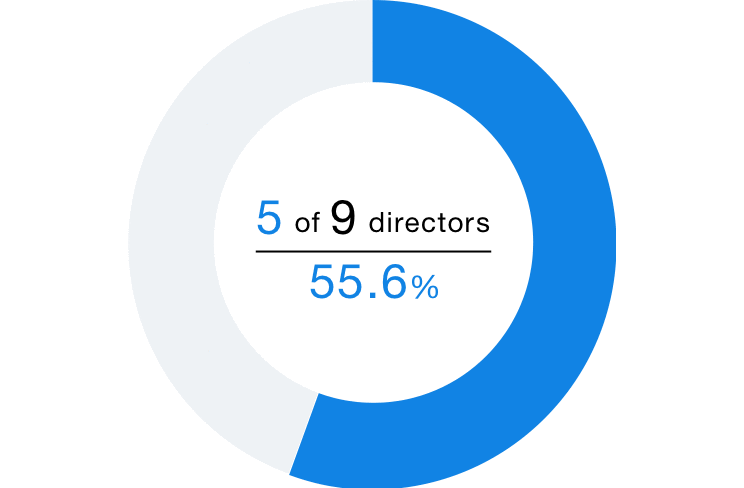
- Five of the six outside directors are designated as independent.
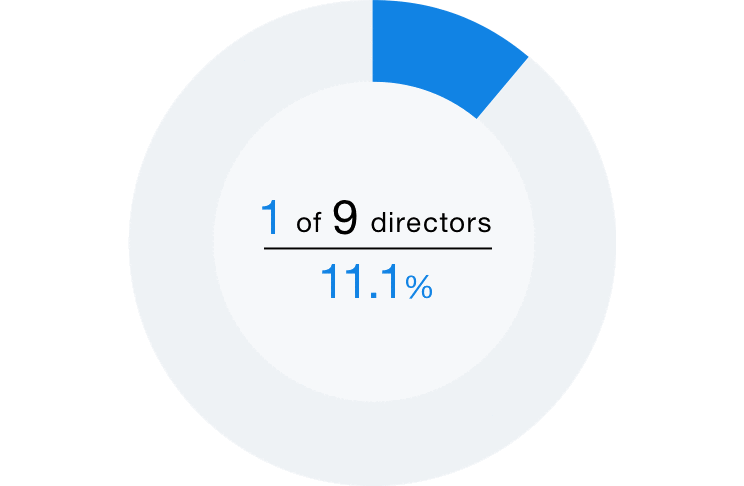
Ratio of Female Directors
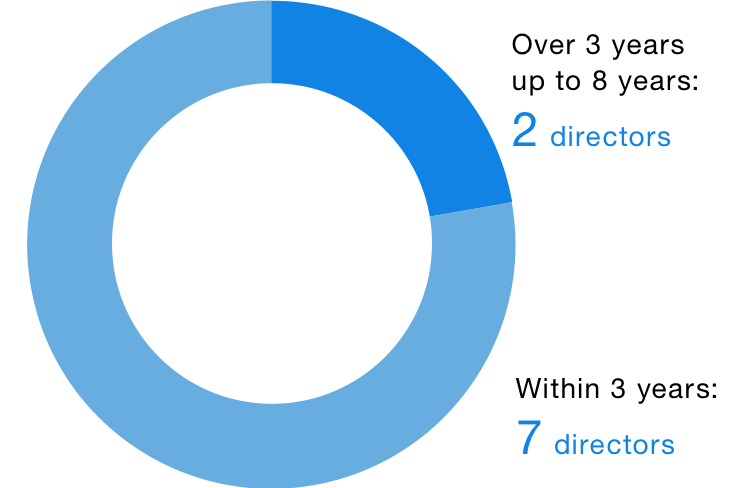
Directors' Length of Tenure
- Five of the six outside directors are designated as independent.
The Board of Directors consists of internal officers who are well versed in business execution and outside officers who oversee management from an objective standpoint.
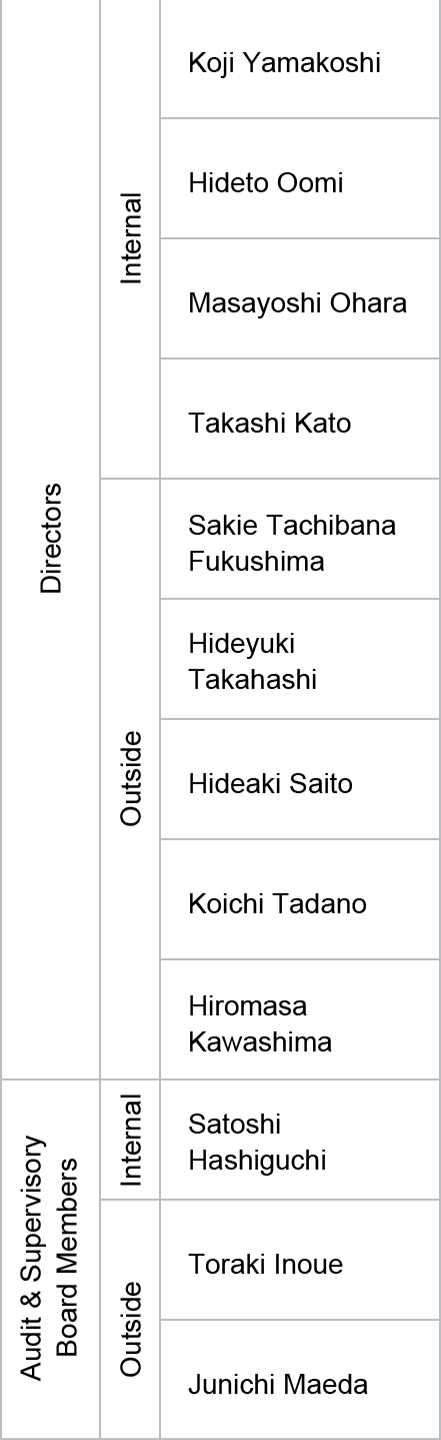
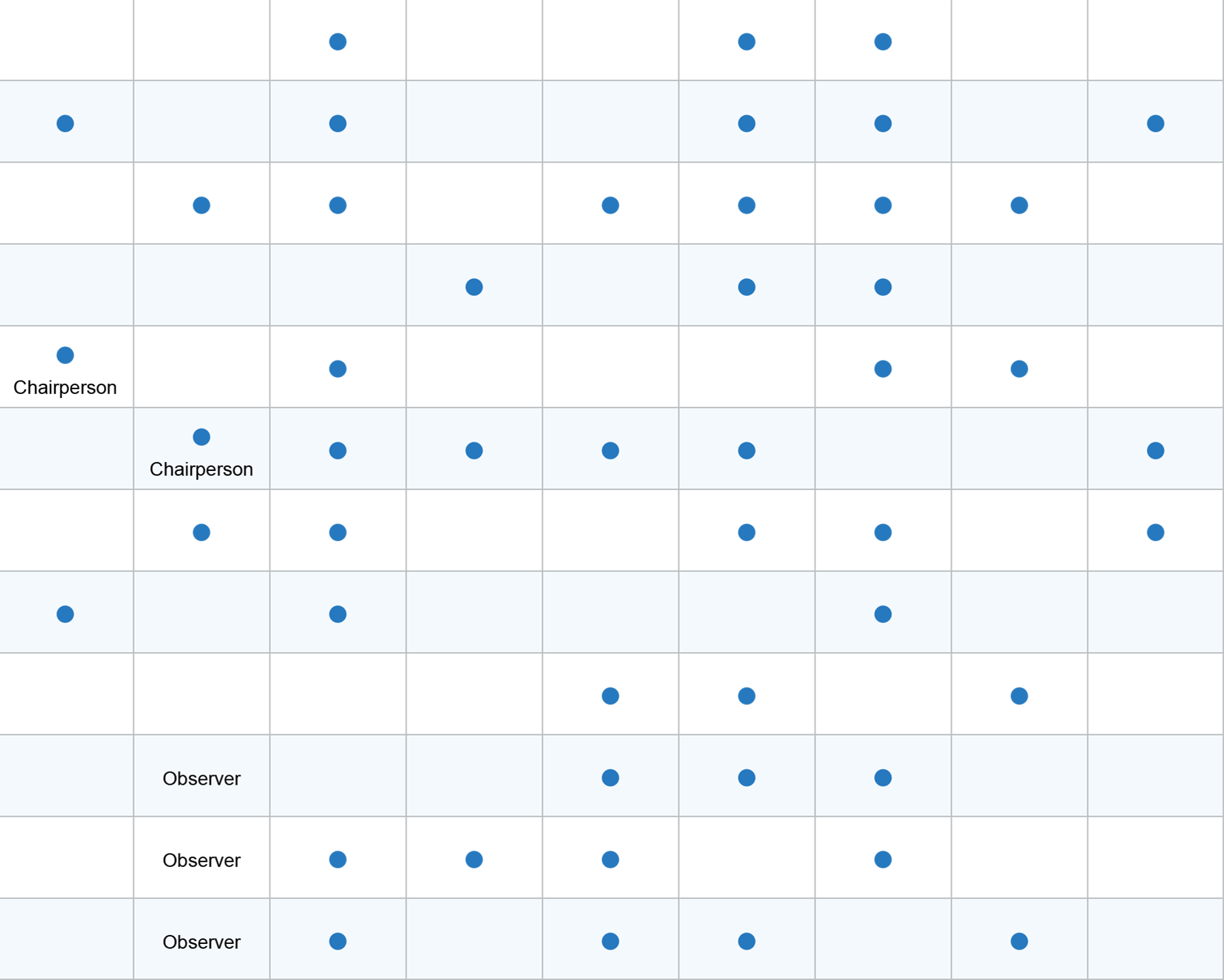
Under our management philosophy—“Contribute to the development of society through the creation of new value-added financial services”—the Bank will strive to achieve sustainable growth and enhance corporate value over the medium to long term by addressing social issues, taking into account perspectives of sustainability such as ESG and DEI*. In order to achieve our goal, the Bank set forth the necessary skills and expertise of directors and Audit & Supervisory Board members as “global affairs” and “IT/digital,” which require higher levels of expertise, in addition to a wealth of knowledge on “corporate management,” “financial accounting,” “legal, compliance/ risk management,” “banking and finance,” and “human capital,” which are the foundations of financial institution management.
- Diversity, equity, inclusion. These are said to be essential elements for the growth of organizations and society.
Expertise Required of Members of the Board of Directors (Knowledge, Experience, and Capabilities)
|
Necessary Expertise |
Definition |
Reasons for Selection |
|
|---|---|---|---|
| Oversight Functions |
Corporate Management |
Experience in organizational management such as a corporate leader |
We consider that insights into and a vision on organizational operations developed through management experience are necessary to achieve sustainable growth and medium- to long-term corporate value enhancement. |
|
Financial Accounting |
Specialized knowledge and experience in financial strategy and financial reporting (accounting and tax affairs) |
We intend to work to achieve sustainable growth by appropriately implementing our capital policy while also ensuring financial soundness. |
|
|
Legal, Compliance/Risk Management |
Extensive and specialized knowledge and experience in laws and regulations, internal controls, and risk management |
We intend to continue fair and sound business operations. |
|
| Aozora’s Focus Areas |
Banking and Finance |
Insight and ability regarding traditional financial business, as well as the ability to explore new areas and create new added-value financial services |
We intend to continue to contribute to the development of society by creating new added-value financial services through our Strategic Investments Business focused on structured finance, which is our area of strength. |
|
Global Affairs |
Insight and ability regarding business expansion and market operations from a global perspective |
We consider that activities that lead to creating value from a global perspective are necessary to develop new services with reference to overseas business models. |
|
|
Human Capital |
Insight into personnel and organizational development, as well as experience and the ability to implement human resources strategies and human capital investment that are linked to our management strategy |
Under the concept that “human capital” is our primary source of value creation, we regard the human resources strategy as part of our management strategy and value human capital. |
|
|
IT/Digital |
Understanding of IT and digital areas, ability in business innovation, and experience in IT/digital businesses |
We consider the IT and digital areas as foundations for our business and customer services and also a significant means that contribute to solutions to the challenges we face. |
|

|

|
|---|---|
|
|
Aozora works to further enhance the effectiveness of its Board of Directors through a continuous improvement process (PDCA cycle) of analyzing and evaluating the Board of Directors’ effectiveness each fiscal year as well as considering and providing solutions to new and existing issues.
The Board of Directors conducts self-evaluations based on each member’s evaluation and opinion regarding the Board’s management, oversight, and other functions that fully draw on the knowledge, experience, and capabilities of each director and Audit & Supervisory Board member. These evaluations are carried out in light of the Board’s fiduciary duties and accountability to the Bank’s shareholders, with the aim of achieving the Bank’s sustainable growth and enhanced corporate value over the medium to long term.
To support our outside directors and Audit & Supervisory Board members, Aozora provides seminars from time to time by inviting experts from outside the Bank. In addition, for newly appointed outside directors and Audit & Supervisory Board members, the executive officer in charge of each business group provides orientation sessions to explain the Bank’s business operations. Prior to assuming their office, newly appointed directors collect and share key information on Aozora’s main governance-related regulations and business operations, and also attend multiple briefing sessions to deepen their understanding of its overall business, as well as finance, IT, human resources, risk management, and sustainability. After assuming office, they keep their understanding of the Bank’s business current, by receiving a briefing on the business situation directly from each responsible officer.
In nominating director and Audit & Supervisory Board member candidates, and appointing and dismissing senior management including the CEO, the Board of Directors takes into account the proper scope and diversity of the positions and has established the following basic guidelines.
- Basic Guidelines for Nominating Director Candidates
- Basic Guidelines for Nominating Audit & Supervisory Board Member Candidates
- Reappointment of Directors and Audit & Supervisory Board Members
- Basic Guidelines for Appointing and Dismissing Senior Management (Executive Officers)
- Basic Guidelines for Appointing and Dismissing the CEO
- For details regarding the nomination of director and Audit & Supervisory Board member candidates as well as the appointment and dismissal of senior management, including the CEO, please refer to the Corporate Governance Report.
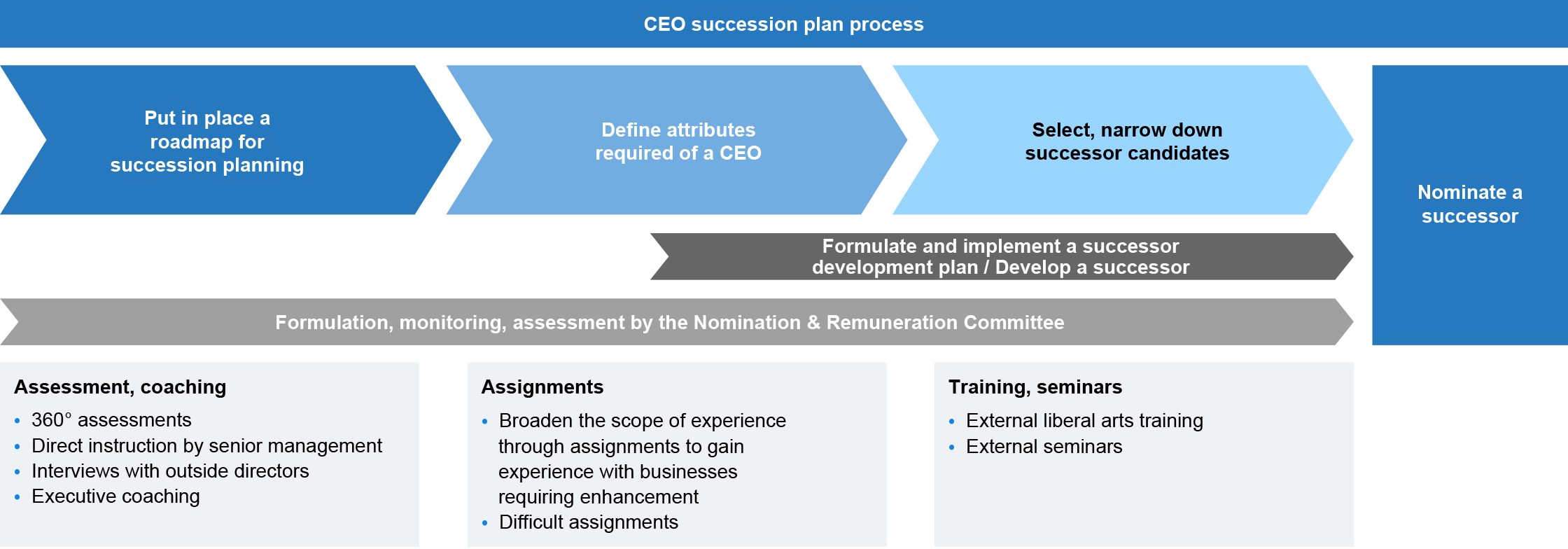
As part of its efforts to achieve sustainable growth and enhance corporate value, Aozora has formulated a CEO succession plan led mainly by the Nomination and Remuneration Committee. Based on this plan, the Bank systematically develops human resources that can embody the management philosophy and take responsibility for senior management positions in the future. As part of the succession plan, Aozora has formulated a roadmap and defined the qualities, capabilities, and work experience for the CEO. This roadmap is then used to select several candidates. Potential candidates are developed and selected through critical work assignments that require enhancement, third-party-based coaching and assessments, and interviews with outside directors.
CEO Succession Plan
Basic Policy for Determining Remuneration for Directors, etc.
In order to realize the Group’s management philosophy to “contribute to the development of society through the creation of new value-added financial services,” Aozora recognizes the necessity of providing proper incentives and a work environment that allows successful and high-potential employees to perform their duties consistently while maintaining high morale, motivation, and pride. To this end, the Bank has designed a remuneration system based on the following basic policy.
- Remuneration framework in line with Bank’s vision
The Bank aims to build a compensation framework that reflects business performance in line with its objectives and values. - Remuneration framework appropriately reflecting the Bank’s performance
The Bank’s remuneration framework is based on “pay for performance” and reflects the Bank’s commitment to sustainable growth, sound risk-taking through appropriate risk management, compliance, and customer protection. - Remuneration framework serving the interests of shareholders and other stakeholders
The Bank has adopted a remuneration framework that is consistent with the values of its shareholders and other stakeholders. - Remuneration methodology that supports effective governance
The Bank ensures that remuneration decisions are made with full transparency and free from specific influence.
Policy on Determination of the Amount and Calculation Method of Remuneration for Directors
The Bank has established the policy regarding the determination of the details of individual directors' remuneration, etc., with the approval of the Board of Directors based on the proposal of the Nomination and Remuneration Committee as a voluntary advisory body. Under this policy, the Nomination and Remuneration Committee, which is mainly comprised of outside directors, determines remuneration payable to each director, with the Board's delegation, from the perspective of ensuring that the remuneration determination process is transparent, independent, and objective.
In principle, the Bank pays fixed-base remuneration, bonus (performance-based remuneration), and equity compensation-type stock options (stock acquisition rights as non-cash remuneration) to internal directors and only fixed-base remuneration to outside directors.
Changes to the Policy on Determination of the Amount and Calculation Method of Remuneration for Directors
With respect to the remuneration structure for internal directors, a resolution was approved at the 93rd Ordinary General Meeting of Shareholders held on June 23, 2026, to change the structure, effective from the performance evaluation period for FY2026, to consist of: base remuneration (fixed-based remuneration), bonus (short-term performance-based remuneration), and performance-linked restricted stock remuneration (medium- to long-term performance-linked and non-cash remuneration). This change is intended to avoid excessive risk-taking and an undue focus on short-term performance, which are not commensurate with the strength of the Bank’s Group, while at the same time strengthening medium- to long-term incentives aimed at improving corporate value, thereby more closely aligning the interests of directors with those of shareholders.
As for the total remuneration framework, in light of the aforementioned objectives, the Bank will maintain the maximum annual amount of 600 million yen for base remuneration and performance-based bonus. At the same time, to contribute to the enhancement of the Bank’s medium- to long-term corporate value and shareholder value, the Bank will discontinue the equity compensation-type stock options remuneration framework (currently a limit of 150 million yen per year), which has been granted at a uniform fixed rate, and instead establish a new annual framework of 250 million yen for performance-linked restricted stock remuneration, the amount of which will vary according to performance. As a general rule, performance-linked restricted stock will be subject to transfer restrictions until retirement as well as to malus and clawback provisions, in order to minimize any impairment of shareholder value.
Policy on Determination of Audit & Supervisory Board Member Remuneration and Calculation
ASB members determine their individual remuneration amounts after discussion among themselves, taking into account the deliberations and proposals made at the Nomination and Remuneration Committee.
ASB members only receive fixed-base remuneration.
Director and Audit & Supervisory Board Member Remuneration Framework (FY2025*)
|
Type of Remuneration |
Payment Eligibility |
Payment Criteria |
||||
|---|---|---|---|---|---|---|
|
Internal |
Outside |
ASB |
||||
| Monetary remuneration |
Base |
Fixed-base |
● |
● |
● |
Using external survey data, Aozora first verifies the appropriate benchmark in accordance with the job title and responsibility on a full-time and part-time basis, after which the Nomination and Remuneration Committee determines the amount of fixed remuneration, which is paid on a monthly basis. |
|
Bonus |
Performance-based |
● |
- |
- |
Following the end of each fiscal year, performance-based remuneration is paid in an amount, determined by the Nomination and Remuneration Committee, within a range of 0% to 250% of the standard amount, which stands at 40% of the base remuneration. The rate and bonus amount for each director are determined based on the following indicators. Quantitative assessment
Qualitative assessment
|
|
|
Equity compensation |
Equity compensation-type stock |
● |
- |
- |
Following the end of each fiscal year, a certain number of equity compensation-type stock options are granted in an amount, determined by the Board of Directors, equivalent to 25% of the base remuneration. |
|
- Equity compensation-type stock options were discontinued and replaced with a performance-linked restricted stock remuneration from FY2026.
For details regarding Aozora’s policy on Group management and its approach to maintaining independence from other affiliated companies, please refer to the Corporate Governance Report.
- For details including achievements, please refer to “Corporate Governance” on pages 52-60 of the Annual Report 2026.
-
(Updated July 2026)